When Your Knowledge Base Contradicts Itself
A knowledge base rarely fails by being empty. It fails when two pages disagree and nobody notices. How contradictions get in, and how to catch them early.
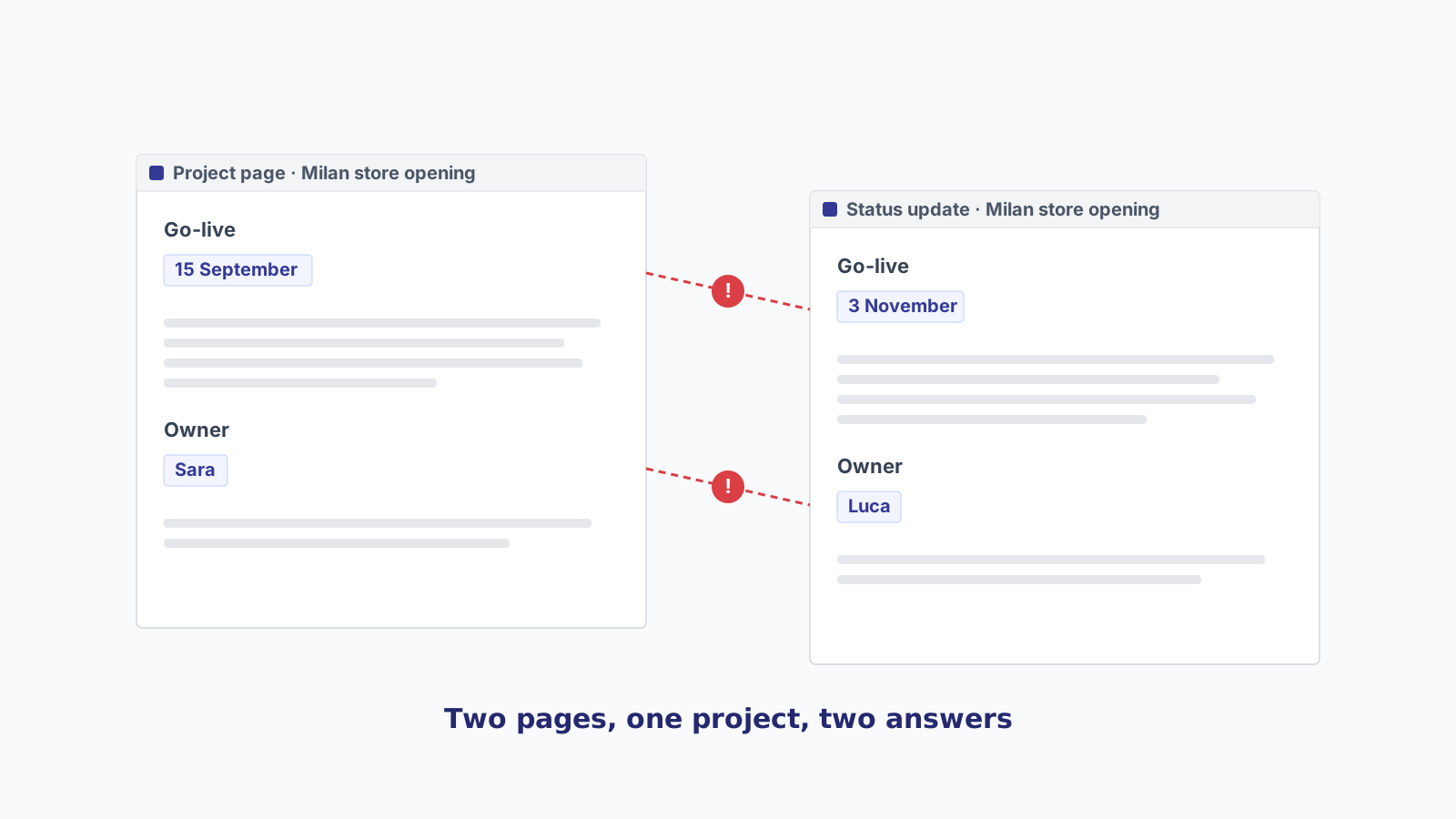
Most advice about knowledge bases is about filling them. Write the pages, pick a structure, name an owner. That advice solves the first problem a knowledge base has. It does not solve the one that kills it later.
The later problem is quieter. A deadline moves in a meeting. A specification changes in a chat. Someone confirms the new version in an email. The page that was supposed to hold all of it was written months ago, and it still says the old thing. Now the company has two answers to the same question, and nothing tells anyone which one holds.
This article is about that moment: how contradictions get into a knowledge base, what they cost, why AI assistants make them more expensive rather than less, and what it takes to catch them while they are still small.
A knowledge base does not go out of date all at once
Nobody decides to let a knowledge base rot. It happens one change at a time, and each change is reasonable on its own.
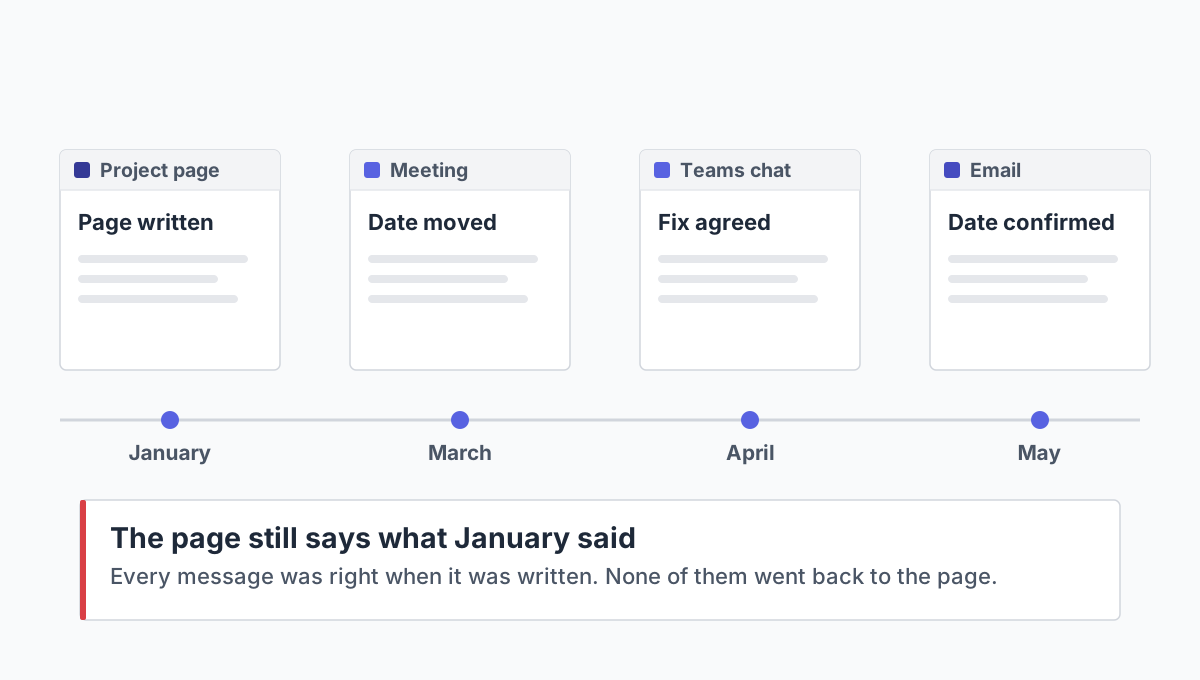
Every message was right when it was written. None of them went back to the page.
A decision is taken in a meeting and written in the minutes. The minutes are correct. A week later the decision is adjusted in a Teams thread. The thread is correct too. Then a client email confirms a third version. Every one of those messages was right when it was written. None of them went back to correct the page that is now wrong.
That is the mechanism, and it is worth naming because it changes what you look for. The knowledge base is not missing information. It has too much of it, in too many places, written at different times. The page is one more source among many, and usually the oldest.
The result looks like this in practice:
- Deadlines: the date everyone still quotes was moved two months ago.
- Specifications: the version in the folder is not the version being built.
- Responsibilities: half the team still asks someone who left the project in spring.
- Decisions: taken twice, in two different ways, because nobody could find the first one.
None of these is a missing page. Each is a page that disagrees with something newer.
Why contradictions are worse than gaps
A gap is honest. When the knowledge base has no page on a topic, you know you have to ask someone. You lose time, but you do not lose trust.
A contradiction is not honest. The page looks finished. It has a title, a date, maybe an owner. You act on it, and you find out later that it was the old version. The next time, you do what everyone eventually does: you check with a colleague before trusting anything you read.
Atlassian’s State of Teams 2025 survey of 12,000 knowledge workers puts a number on where that leads. 56% of workers say they often find that the only way to get the information they need is to ask someone or schedule a meeting. The same report notes that people who do find something relevant “usually have no way of knowing if it’s up-to-date.” It is a vendor-published survey, so read it as a signal rather than a census. But the pattern it describes is the one every knowledge manager recognises: once people stop trusting the pages, they stop reading them, and then they stop updating them.
That is why one contradiction costs more than one page. It changes how people use all the others.
Where contradictions come from
It helps to be specific, because each source needs a different fix.
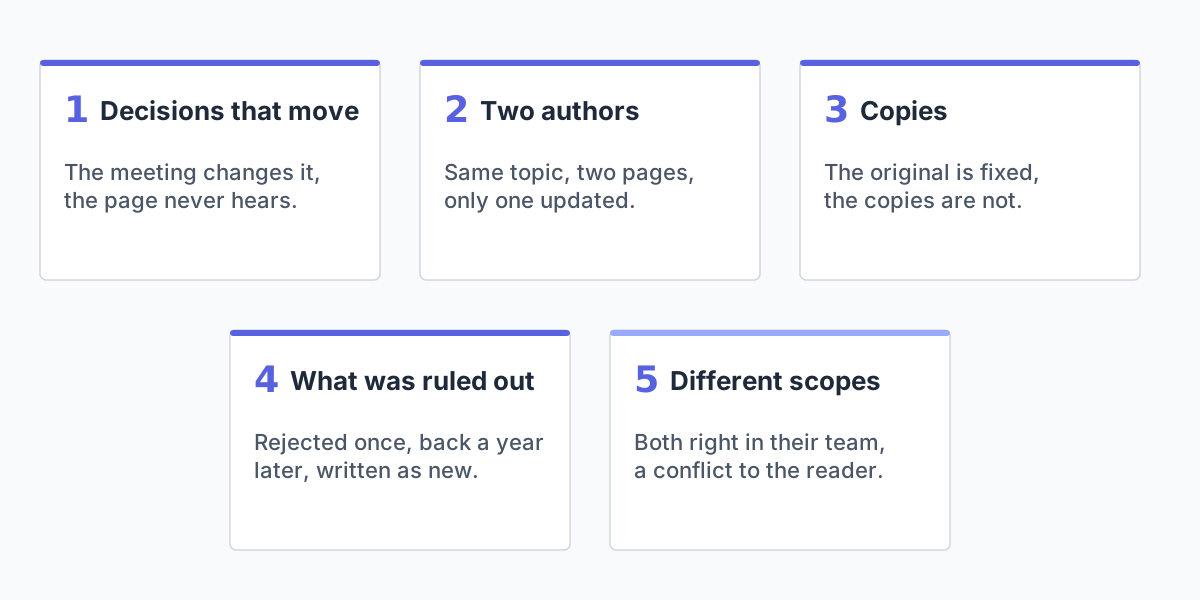
Five ways a knowledge base falls behind, or looks like it does.
Decisions that move after they are written down. The most common case. A page records what was decided, and the decision changes in a conversation the page never sees.
Two people documenting the same thing. One writes the onboarding steps for the sales team, another for support. Both are accurate on the day they are written. Six months later, only one of them was updated.
Copies. A procedure is pasted into a project page, a slide deck and a handover document. The original is corrected. The copies are not.
What was ruled out. Teams rarely write down the options they rejected and why. A year later the same option comes back, is discussed again from scratch by people who were not there, and gets documented as if it were new, next to the old page that recorded the opposite decision.
Different scopes that read as the same rule. “Approval is required above 10,000” in one department and “above 5,000” in another may both be right. On two pages with no context, they look like a contradiction, and readers cannot tell which applies to them.
The first four are the knowledge base falling behind the company. The last one is not a real conflict, but to a reader it looks exactly like one.
Why the usual maintenance advice misses them
The standard answer to stale content is a review cycle: assign an owner, review each page every quarter or every six months, archive what is no longer read.
Review cycles are useful. They catch pages that nobody needs any more. But they check a page against itself and against the calendar. They do not check it against what was said in last Tuesday’s meeting. A page can pass its quarterly review on the day after the decision it describes was changed, because the reviewer was not in that meeting either.
Usage signals have the same limit. A page that is read every day looks healthy in any analytics dashboard. If it carries a wrong date, it is not healthy. It is spreading the wrong date faster.
To catch a contradiction you need to compare the page with the newer information, at the moment the newer information appears. That is a different job from reviewing pages on a schedule, and most tools are not built for it.
AI assistants make contradictions more expensive
It is tempting to think AI solves this. Put an assistant on top of the knowledge base, and it will find the right answer wherever it is.
The research says the opposite: when sources disagree, assistants are bad at choosing.
A benchmark called ClashEval, presented at NeurIPS 2024, tests what happens when the documents a model retrieves contain wrong information. Across more than 1,200 questions in six domains, its authors found that leading models are “susceptible to adopting incorrect retrieved content, overriding their own correct prior knowledge over 60% of the time.” They also found that the less confident a model is in its own answer, the more likely it is to take the retrieved content at face value.
A second study, DRAGged into Conflicts, looked directly at conflicting sources and concluded that language models “often struggle to appropriately resolve conflicts between sources.” Asking the model to reason explicitly about the conflict helped, but the authors note that “substantial room for improvement” remains. It is a 2025 preprint, not yet a settled result. We go through both studies on our page about what happens when an AI knowledge base answers from pages that disagree.
Now apply that to a company knowledge base. ClashEval tested general-knowledge questions, where the model at least has some prior knowledge to fall back on. For your project deadlines, your approval thresholds and your supplier terms, it has none. That is our inference, not a finding of the study, but it follows directly: on internal facts, the assistant can only repeat what the pages say. If two pages disagree, it will answer from one of them, fluently and with no warning, and the reader has even less reason to doubt it than they had to doubt the page.
An assistant on a contradictory knowledge base does not remove the contradiction. It hides it behind a confident answer.
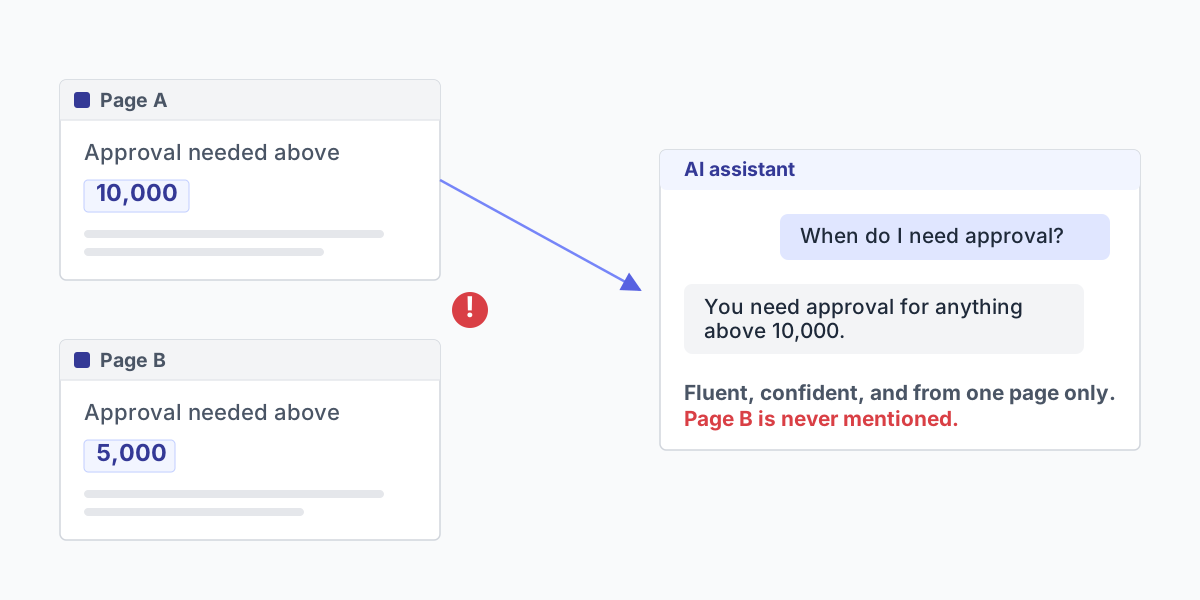
An illustrative example: the assistant answers fluently from one page and never mentions the other.
What catching a contradiction actually requires
If review cycles and assistants are not enough, what is? Four things, and they are independent of any product.
- Compare at the moment of change, not on a schedule. The contradiction is born when the new information appears: the meeting, the thread, the email. That is when the comparison is cheap, because the person who changed the decision still remembers why.
- Compare against what is already written. Noticing that something new was said is easy. Noticing that it disagrees with a page written in March is the hard half.
- Ask a person, do not overwrite. Sometimes the newer message is the mistake. Sometimes both are right in different scopes. A contradiction is a question for the team, not a decision for a script.
- Leave a trace. When the team decides which version holds, the page should say what changed and where the decision came from, so the next reader does not repeat the argument.
Most knowledge bases do none of these automatically, which is why they depend on someone with the time, the memory and the authority to do all four by hand. In most companies, that is nobody’s job.
How SecondBrain 365 handles it
This is the problem we built SecondBrain 365 around. It is an AI agent with its own company email inside your Microsoft 365. You put it in copy, and the project knowledge base writes itself as pages on SharePoint.
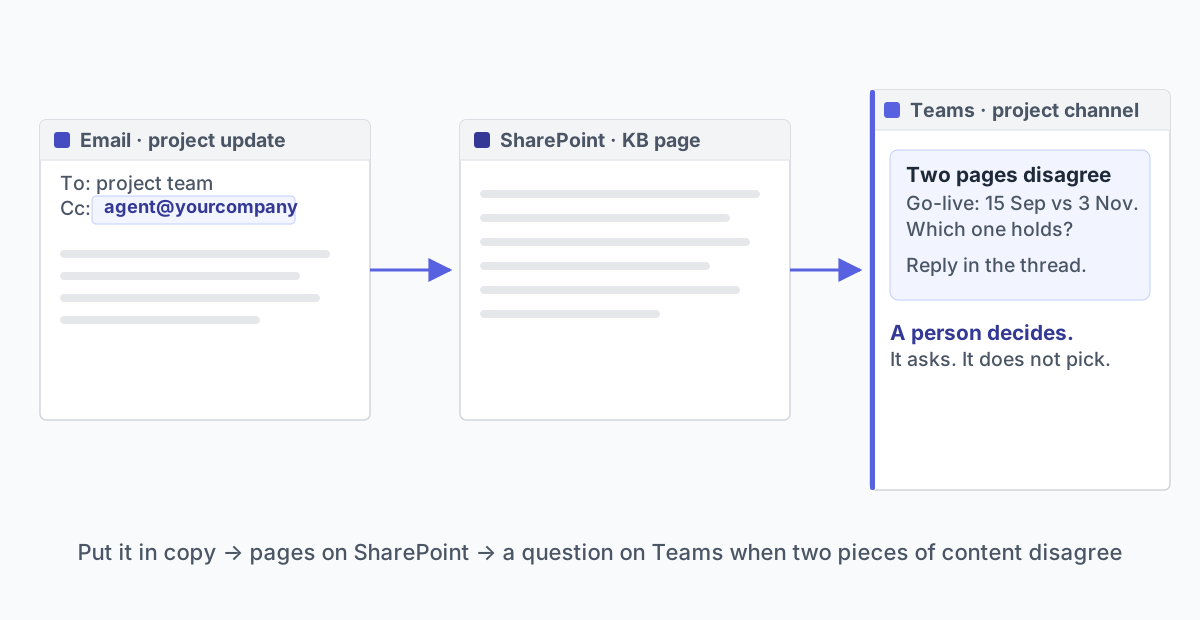
An illustrative example: the agent asks which version holds. A person decides.
The part that matters here is what happens next. When two pieces of content contradict each other, it posts on Teams so that you decide which one holds. It does not pick a winner on its own. If you turn on the approval step, nothing enters the knowledge base until a person says yes.
Everything stays in your tenant: the pages live in a SharePoint site you own. And because the pages live in SharePoint, Microsoft 365 Copilot reads them like any other content, which means the answers it gives about your projects come from pages someone has kept consistent. See how it works.
It is not a promise that your knowledge base will never be wrong. New information will keep arriving faster than anyone can document it. The point is to find out about a contradiction from a message on Teams, rather than the day someone acts on the wrong page.
A short checklist you can use this week
You do not need a new tool to start finding contradictions. Pick one active project and try this:
- List the five facts people ask about most: deadline, owner, scope, budget holder, current version of the main document.
- Find every place each fact is written: the project page, the latest minutes, the last status email, the slide deck.
- Mark the ones that disagree, and for each, ask the person who would know which version holds.
- Fix the page and write down why, with a link to the message where the decision was made.
- Note how long it took. That is the size of the job nobody is currently doing.
If you want a broader view of keeping pages honest, our guide to maintaining an internal knowledge base covers the habits that work and the ones that only look like they do.
Frequently asked questions
What is a contradiction in a knowledge base? Two pieces of content that give different answers to the same question, where only one can be right for the reader: two deadlines for the same milestone, two versions of the same procedure, two owners for the same task.
How is a contradiction different from outdated content? Outdated content is wrong compared with reality. A contradiction is wrong compared with something else the company has written, which means it can be detected by comparing sources, without anyone having to notice the change in the real world first.
Can an AI assistant tell me which version is correct? Not reliably. Research such as ClashEval and DRAGged into Conflicts shows that language models often follow whichever retrieved source they are given, even when it is wrong. For internal company facts, a person who knows the context still has to decide.
How often should we review our knowledge base? A calendar review is useful for archiving pages nobody reads. It does not catch contradictions, because those appear when information changes, not when the review is due. The more useful question is how quickly a change in a meeting or an email reaches the page.
Does SecondBrain 365 replace the people who maintain our documentation? No. It takes over the writing: turning what is said in copy into pages, and flagging when something new contradicts something already written. The decision about which version holds stays with your team.
Where does our data go? Nowhere new. The agent lives in your Microsoft 365 tenant, and the knowledge base is a SharePoint site you own.
If you have two pages that no longer agree and want to see what this looks like on your own project, book a demo.

Giuseppe Marchi